
Humans moving closer to
extinction, study says
Friday, January 5, 2001
By ROBERT McCLURE
SEATTLE POST-INTELLIGENCER REPORTER
Standing at the brink of the new millennium, it looks like mankind is rapidly overtaking the Earth's capacity to support humans, and it's possible we are on a path toward extinction, according to a sweeping study to be published today.
The report reviews a wide array of environmental indicators during the past century, including public health, food supply, fresh water, oceans and forests.
|
|
|
|
|
|
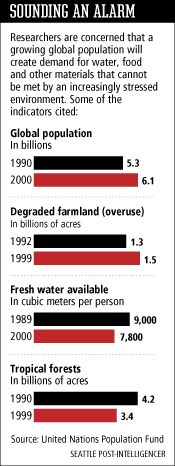
"In the past decade, in every environmental sector, conditions have either failed to improve, or they are worsening," says the report, titled "Population and the Environment: The Global Challenge." It was written by Don Hinrichsen, a consultant to the United Nations Population Fund, and Bryant Robey, editor of the Johns Hopkins University journal Population Reports. Robey, as the journal's editor, reviews dozens of population studies annually.
"Without practicing sustainable development, humanity faces a deteriorating environment and may even invite ecological disaster," the authors wrote. "Are we setting the stage for our own extinction?"
Among the evidence cited:
- Increasing water use that accompanies development of modern societies. While population tripled in the 20th century, water use increased sixfold.
- Coastal wetlands that nourish many varieties of sea life are rapidly disappearing in the face of development. Their extent was reduced by half in the past century.
- Seagrass beds that shelter fish and other marine life also are vanishing, along with coral reefs that are called the "rain forests of the ocean" because they nurture so many varieties of fish and other creatures.
- Forests, which conserve water and produce oxygen, among other benefits, are being cut down. In the past 50 years, nearly half the world's forest cover was lost -- about 7.4 million acres.
- About 5,200 species of animals are threatened with extinction. Plants also are at risk; about 30 percent of 16,000 known plant species in the United States are at risk of dying off.
- Air pollution kills more than 2.7 million people annually.
- Food is growing more scarce. While the worldwide population grew 1.7 percent from 1990 to 1997, grain production increased by just 1 percent. About 2 billion people -- a third of the world's population -- don't have enough to eat.
Yet, the picture is not completely bleak, the authors wrote. Progress is being made in using energy more efficiently, planning cities, managing water resources, preserving forests, curbing pollution, managing fisheries and spawning a new "green revolution" in which more-versatile crops are developed.
Those positive trends should have gotten more attention in the report, said Jay Lehr, science director of Chicago-based Heartland Institute, a Libertarian think tank often at odds with environmentalists.
"It's the most encompassing report of its kind that I've seen, but they had to have in mind before they started to write to describe the gloomiest scenario they could," Lehr said.
For example, he said, although forests are being reduced on a global scale, they are being restored in the United States, including in the Pacific Northwest.
And, Lehr said, the report focuses heavily on health problems that could better be solved through more development -- not less.
"You can draw a straight line between economic development and environmental protection," Lehr said. "You've got to raise people up with economic development and creature comforts before people are going to care at all about the environment.
"This report has it backwards."
Hinrichsen defended his report, saying it calls for improvements in sanitation living standards through improved agriculture and water use.
"One of the things we tried to do was look for positive trends, positive developments, and it's hard to find them among the gloom-and-doom," he said.
The slowing of the rate of population growth is the most promising development of the recent past, the authors said.
In the second half of the 20th century, world population growth outstripped all the population increases in the prior 4 million years. But the growth rate slowed in the 1990s to about 1.4 percent, down from 2 percent a decade earlier.
Richard Morrill, a University of Washington professor emeritus of geography, had not yet seen the report, but said it sounded familiar.
"It's obvious that all those problems exist, and they are much more intractable in development countries," he said. "People said exactly the same thing 10 years ago, 20 years ago, 30 years ago and 40 years ago. . . . These problems are severe, but we don't solve them by exaggerating how imminent they are."
P-I reporter Robert McClure can be reached at 206-448-8092 or robertmcclure@seattle-pi.com